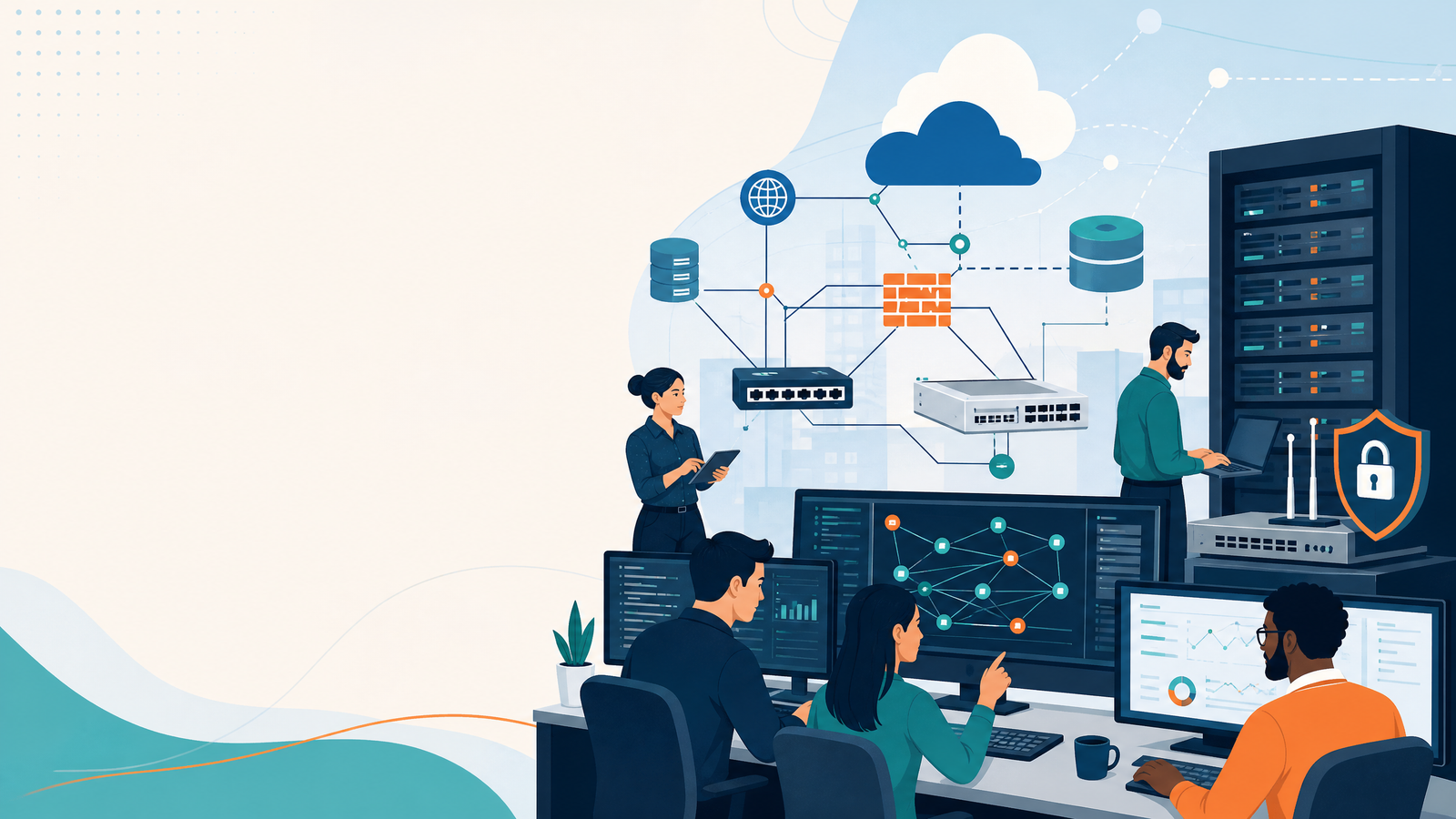
How to Design a Reliable Networking and Systems Environment
A reliable network and systems environment keeps people, applications, data, and services connected safely. Strong infrastructure is not only about buying faster equipment; it is about designing predictable connectivity, clear operating procedures, security controls, monitoring, and recovery plans that support business goals.
Start with Requirements and Constraints
Document users, sites, applications, traffic patterns, availability targets, latency needs, growth expectations, and compliance requirements. Identify critical services, acceptable downtime, recovery objectives, and dependencies before choosing network or server architecture.
Map the current environment
Create an accurate inventory of switches, routers, firewalls, wireless access points, servers, cloud connections, circuits, software versions, and ownership. A living topology diagram and asset register make troubleshooting faster and reveal single points of failure.
Design for Resilience
Use redundancy for critical paths, power, connectivity, and services where the business requires continuity. Plan link failover, device replacement, capacity headroom, backup configurations, and tested recovery procedures. Avoid complex redundancy that no one can monitor or operate confidently.
Segment users, servers, applications, guest access, management traffic, and sensitive workloads according to risk and communication needs. Clear boundaries limit the impact of faults and make security policies easier to apply.
Build Security into Connectivity
Apply least privilege to network access, administration, service accounts, and remote connections. Use strong authentication, secure management protocols, firewall policies, network segmentation, endpoint controls, and timely patching. Review rules regularly and remove unused access instead of allowing exceptions to accumulate.
Protect the management plane
Restrict administrative interfaces to approved networks or secure access paths, separate management credentials from everyday accounts, and log configuration changes. Store secrets safely and maintain an emergency access process that is audited after use.
Monitor Performance and Health
Track availability, latency, packet loss, bandwidth, interface errors, CPU and memory, storage capacity, certificate expiry, backup status, and authentication failures. Establish baselines so teams can distinguish normal peaks from emerging problems and set alerts that lead to clear actions.
Centralize logs and correlate events across network devices, systems, cloud services, and applications. Dashboards should show business impact, not only technical counters, and runbooks should explain verification, mitigation, escalation, and follow-up.
Document and Automate Operations
Standardize naming, addressing, configuration templates, change reviews, maintenance windows, and rollback steps. Automate repeatable tasks such as provisioning, compliance checks, backups, and inventory updates while keeping changes traceable and reversible.
Train more than one person on critical procedures. Regularly review diagrams, credentials, vendor contacts, licenses, and support agreements so the environment remains operable during incidents and staff transitions.
Conclusion
Reliable networking and systems environments are designed around requirements, resilience, security, observability, and operational discipline. With accurate documentation and tested controls, teams can reduce outages, resolve incidents faster, and scale infrastructure without losing confidence in its stability.